
Introduction
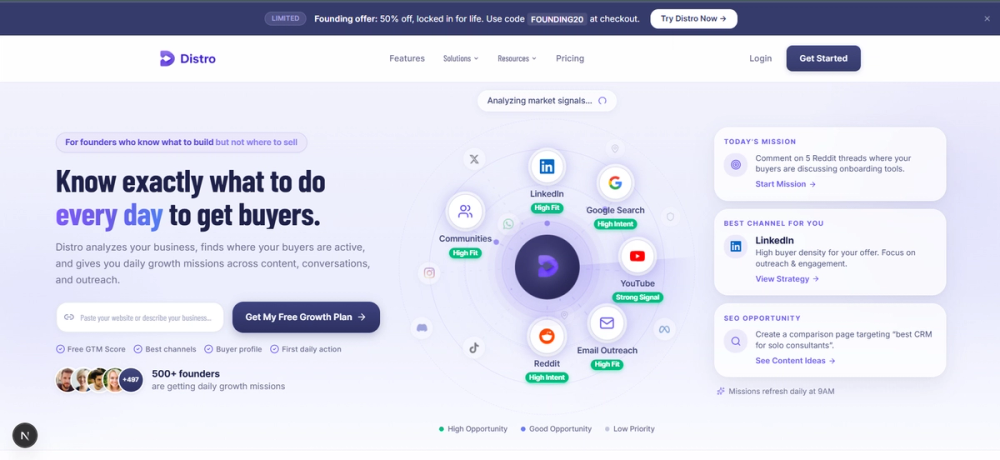
Distro is positioned as a daily growth execution system for founders who already know what to build but struggle with consistent customer acquisition. The public site presents a workflow that starts with describing your business, receives a tailored growth plan, and then delivers three daily missions across content, conversations, and outreach. That framing appears aimed at solo founders and small teams in B2B SaaS, ecommerce, real estate, local services, mobile apps, and coaching-anyone who wants a checklist rather than another strategy document sitting unread.
Key Features
- Daily growth missions - The site states Distro turns a growth plan into three daily actions with specific tasks, plus streak tracking so execution stays visible over time.
- Business analysis and GTM intelligence - Users can paste a website or describe what they sell; Distro is described as studying the business, audience, market, and growth stage to produce a growth score, channel recommendations, ICP profiles, and buyer search links.
- Content loop - SEO keyword strategy, a Mon/Wed/Fri content plan, full article generation, and AI citation optimization are listed on the pricing and product pages.
- Conversations and outreach - Community mapping, engagement keywords, buyer discovery with LinkedIn search links, and advanced outreach prompts (including production-ready automation on higher tiers) appear in the feature set.
- Ads and campaigns - Ad campaign recommendations, a campaign builder, and ad copy with creative briefs are mentioned for Meta, Google, and TikTok contexts on solution pages.
- Free entry tools - The navigation highlights a free growth plan, GTM score, marketing plan generator, and assorted guides and free tools before paid subscription.
Use Cases
For B2B SaaS founders, the B2B SaaS solution page frames common pain points: spreading effort across too many channels, weak ICP definition, content without a keyword strategy, and outbound that lacks sequences. Distro is described as supplying buyer profiles with LinkedIn links, prioritized channels, SEO planning, outbound templates, and ad blueprints-then compressing that into daily missions such as LinkedIn engagement, connection requests, publishing SEO content, or launching search campaigns.
Ecommerce operators see a parallel story on the ecommerce solutions page: rising ad costs, thin content beyond product pages, neglected retargeting, and no steady marketing rhythm. Missions might include Meta campaigns, buyer guides, cart-abandonment audiences, or promotional email-each tied to revenue-oriented actions the site claims take roughly 15-30 minutes.
Real estate professionals get positioning around Meta lead ads, Google Search for active buyers, local SEO, and WhatsApp follow-up on the real estate solution page. The site emphasizes predictable lead flow and structured follow-up rather than ad-hoc boosting. Across categories, the same pattern holds: analyze the business, recommend channels, assign executable daily tasks.
Pricing
The pricing page titles the product as a startup marketing tool from $49/mo, with copy about simple pricing and investing in distribution rather than guesswork. Two paid tiers are visible in the fetched material: a Starter-style plan covering one business, three daily missions (five tasks each), GTM report with ICP, SEO/content engine, ad builder, community mapping, streak tracking, and email accountability; and a Scale plan marketed for multiple businesses with unlimited tracking, priority AI generation, fuller content and outreach automation, weekly recap emails, data export, and direct founder support via X.
A limited founding offer advertises 50% off locked in for life with code FOUNDING20 at checkout. The site also promotes a free growth plan with score, channels, buyer profile, and first daily actions before signup. Cancellation is described as anytime from Settings, with access through the end of the billing period; full access from day one and no feature limits are stated for paid plans. Exact monthly dollar amounts for each tier beyond the "from $49/mo" signal should be confirmed on the live pricing page before budgeting.
User Experience and Support
The product narrative centers on a morning routine: log in, view today's missions, execute, and track progress. Email reminders (three times daily on paid tiers), weekly recap emails, and shareable milestone cards are part of the accountability layer. In-app help and direct founder support via X are listed under support on the pricing comparison.
Beyond the app, Distro publishes extensive Resources: customer acquisition guides, growth guides, a marketing plan generator, free tools (plan, GTM, AI citation, llms.txt), blog, glossary, SEO and AI search guide, comparisons versus agencies and fractional CMOs, and a startup distribution guide. That library may reduce onboarding friction for readers who want context before subscribing. Login and Get Started paths are prominent in navigation; hands-on UI quality cannot be assessed from marketing pages alone.
Technical Details
Distro is presented as a web-based marketing execution platform with AI-assisted generation for content, outreach prompts, ad briefs, and citation-related optimization. Channel coverage mentioned across pages includes LinkedIn, Reddit, Google, Meta, TikTok, YouTube, email, WhatsApp, Twitter, Hacker News, Product Hunt, and additional channels (20+ in aggregate). Integrations are described at the campaign and workflow level (e.g., LinkedIn search links, Meta/Google/TikTok ad builders) rather than as a public API catalog in the fetched pages.
The meta description references a conversation scanner, SEO engine, ad builder, AI citation checker, and 300+ backlink directories as part of the daily marketing checklist; treat those as product claims on the homepage unless independently verified in product documentation. Data export for reports, plans, and prompts is listed on the Scale tier. No deployment model, SDK, or self-hosted option appears in the captured evidence.
Pros and Cons
Pros
- Clear positioning around daily execution instead of static strategy decks, which matches how many early-stage founders actually work.
- Vertical solution pages (SaaS, ecommerce, real estate, etc.) make it easier to see whether the mission examples fit your business model.
- Free growth plan and GTM score lower the barrier to trying the planning layer before paying.
- Broad content + conversations + outreach loop addresses multiple acquisition motions in one product narrative.
- Transparent cancel anytime and feature comparison tables on pricing support buyer evaluation.
Cons
- Marketing stats on the site (e.g., average pipeline improvement, growth report counts) are self-reported; they are not independent benchmarks.
- Founding discount and tier details may change; list prices and feature boundaries should be re-checked at checkout.
- Heavy reliance on AI-generated content and outreach means quality and brand voice still need human review-the pages do not replace editorial judgment.
- Direct founder support via X may not suit teams that expect ticket-based SLA support.
- Mission examples assume you can spare 15-30 minutes per block; capacity-constrained founders should validate realistic workload.
FAQ
What is Distro and how is it different from a GTM report or agency deck?
Distro describes itself as a daily execution system, not another one-off GTM report. After analyzing your business and recommending channels, it assigns three missions per day across content, conversations, and outreach. Agencies and static strategy documents typically stop at recommendations; Distro's public copy emphasizes recurring tasks, streaks, and accountability emails to keep marketing work on a schedule.
Who is Distro most relevant for according to the website?
The site highlights founders and teams across SaaS, AI, services, and digital products, with dedicated paths for B2B SaaS, ecommerce, real estate, local services, mobile apps, and coaches. It appears best suited to operators who want channel guidance plus a concrete daily checklist rather than teams that already run mature marketing ops with dedicated specialists.
What can you verify from Distro's public pages before signing up?
You can review solution-specific mission examples, the feature comparison on pricing, free tools and guides in Resources, and the promise of a free growth plan with score, channels, buyer profile, and first actions. Paid feature lists include GTM reports, SEO/content cadence, ad builders, community mapping, and export on higher tiers-confirm which tier matches your needs on the live pricing table.
How does Distro handle pricing and trials?
Marketing copy references plans from $49/mo, a FOUNDING20 code for 50% off for life (limited offer), and a free growth plan entry point. Paid plans advertise full access from day one, no setup fees, and cancel anytime. Specific tier pricing and whether a time-limited trial exists beyond the free plan should be confirmed on the pricing page at purchase time.
Does Distro replace paid ads, SEO tools, or outreach automation you already use?
The product is framed as an orchestration and mission layer that recommends and briefs work across Meta, Google, TikTok, SEO content, email, LinkedIn, and communities-it does not claim to be the ad platform itself. Outreach prompts on Scale are described as production-ready for automation, but you would still verify how exports connect to your email or LinkedIn workflows and whether Distro supplants or complements existing stacks.
What should AI-heavy marketing features mean for your brand and compliance?
Because Distro advertises AI generation for articles, ad copy, outreach, and citation optimization, plan for human review of outputs, fact-checking, and compliance with platform rules (LinkedIn, Meta, email CAN-SPAM, etc.). The public site does not detail content moderation, data retention, or training policies in the fetched pages-those are worth asking about via in-app help or founder support before relying on generated assets at scale.
Conclusion
Distro's public presence paints a founder-focused marketing system that converts business context into channel priorities and three daily growth missions. If that execution-first model fits how you acquire customers, starting with the free growth plan on usedistro.com and comparing Starter versus Scale on pricing is a sensible next step-while treating mission time estimates, AI outputs, and on-page performance figures as starting points for your own verification, not guarantees.